DCV vs RPZ vs PVB: A Clear, Trusted Florida Backflow Guide
DCV vs RPZ vs PVB is the question almost every Florida property owner asks the first time they pull up their irrigation meter and see a brass assembly they cannot identify. The short answer: three different devices, three different jobs, three different scenarios where each one is required by Code. The longer answer is below, written by a Florida BAT-certified tester who tests all three weekly in North Port and Englewood.
Each section names where the device is required, what it does mechanically, the typical Florida sizing, and how the annual test runs on each one. By the end you should know which one is at your property and why.
Table of contents
- The 3 backflow preventer types at a glance
- PVB (Pressure Vacuum Breaker)
- DCV (Double Check Valve)
- RPZ (Reduced Pressure Zone)
- How to tell which backflow preventer is at your property
- Why the device type changes your annual testing process
- Frequently asked questions
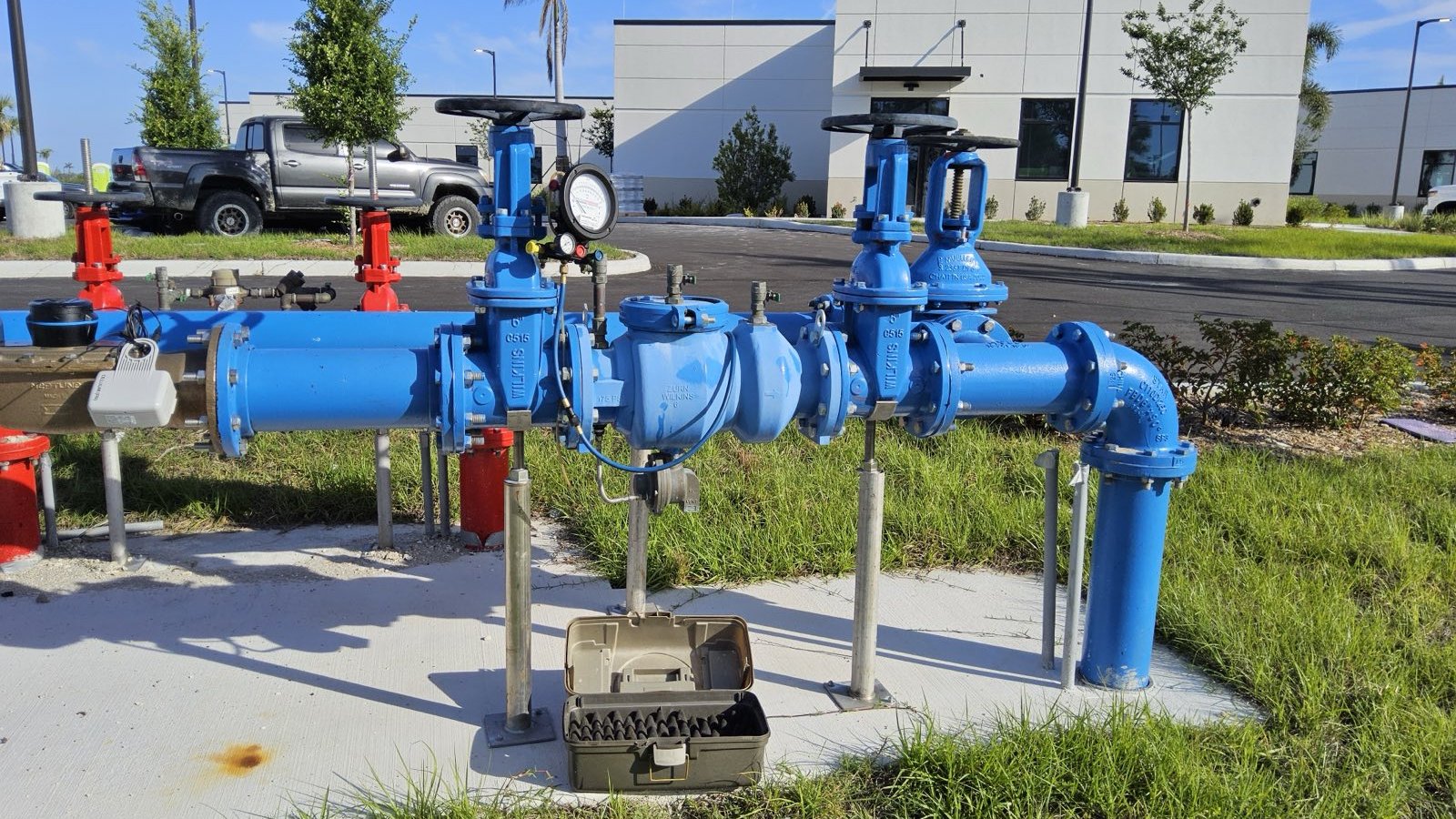
The 3 backflow preventer types at a glance
| Type | Full name | Hazard rating | Typical Florida use | On-site test time |
|---|---|---|---|---|
| PVB | Pressure Vacuum Breaker | Low to moderate | Residential irrigation | About 20 minutes |
| DCV | Double Check Valve | Low to moderate | Fire-sprinkler risers, low-hazard irrigation | 25 to 30 minutes |
| RPZ | Reduced Pressure Zone | High hazard | Commercial, medical, irrigation w/ chemical injection | 30 to 45 minutes |
All three are approved cross-connection control devices under Florida Administrative Code 62-555.360(2) when used in the correct application. The wrong device on the wrong application is a Code violation regardless of whether the assembly passes its annual test.
PVB (Pressure Vacuum Breaker)
The PVB is the workhorse of Florida residential backflow protection. If you live in North Port or Englewood and have an in-ground irrigation system, you almost certainly have one.
Where you will find a PVB in Florida
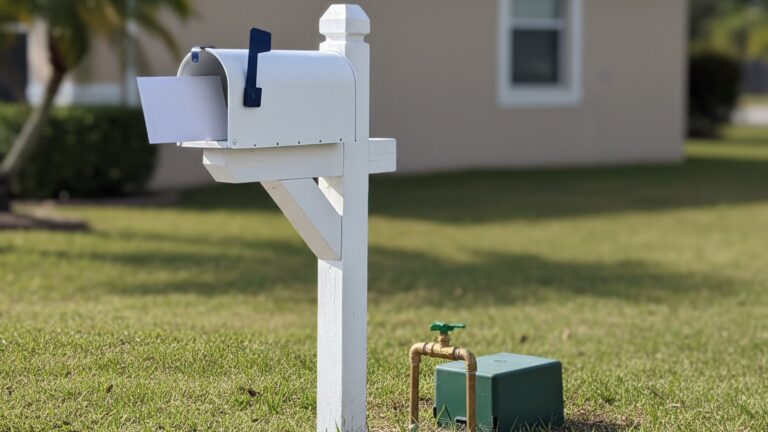
PVBs sit above ground next to the irrigation meter. Florida Code requires the assembly to be installed at least 12 inches above the highest sprinkler head, which means you usually see them mounted vertically with the test ports facing outward. Common locations: the side of the house next to the irrigation meter, a dedicated pad in the front yard near the sprinkler timer, or against the exterior wall of an attached garage where the irrigation supply enters.
What a PVB does mechanically
A PVB protects against backsiphonage, which is what happens when pressure in the public water main drops suddenly (a main break two streets over, a fire hydrant flushing too fast) and water from your irrigation line gets pulled backward toward the lower-pressure side. The PVB has a check valve and an air-inlet (atmospheric vent) that opens when pressure drops, breaking the siphon and stopping the backflow. PVBs do not protect against backpressure (water being pushed back by a pressurized source on your side), which is why they are not allowed on commercial RPZ applications or anywhere chemical injection is in play.
Florida sizing typical
Three-quarter-inch PVB and one-inch PVB are the standard residential sizes in North Port and Englewood. Larger PVB (1.25-inch, 1.5-inch) shows up on some HOA irrigation systems and small commercial properties with low-hazard cross-connections. Common manufacturer models in Charlotte County: Wilkins 720A, Febco 765, and Apollo 4ALF in PVB configuration.
How the annual PVB test runs
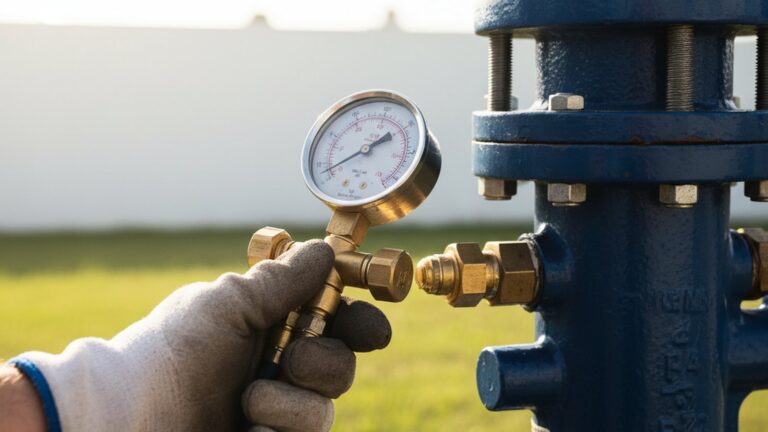
Twenty minutes on site for a typical residential PVB. We attach the calibrated differential pressure gauge to the test ports, close the shutoffs in sequence, watch the gauge as the check valve closes and the air inlet opens, record the readings on the certified test report, restore the shutoffs, and re-verify the assembly holds pressure. The fastest of the three device tests.
DCV (Double Check Valve)
The DCV is most common on fire-sprinkler risers and on commercial water service lines for low-hazard applications. You see them less often on residential properties but they do show up.
Where you will find a DCV in Florida
DCVs are typically installed where Code requires double-check protection but the hazard does not rise to the level requiring an RPZ. The two most common places we test DCVs in Charlotte County: fire-sprinkler risers (where the fire-line connection meets the building) and low-hazard commercial water service (some restaurant water lines, some industrial water-only feeds with no chemical involvement). On the residential side, a few HOA properties use DCVs on community irrigation systems.
What a DCV does mechanically
A DCV uses two check valves in series. Each check is spring-loaded to close against reverse flow, and the two-in-series design means even if one check leaks, the other holds. DCVs protect against both backsiphonage and low-pressure backpressure, but they do not have a relief valve like an RPZ, which means they are not approved for high-hazard applications where the potential contaminant is dangerous (chemical injection, medical, dental, sewage adjacency).
Florida sizing typical
DCV sizing depends on the application. Residential and small commercial usually run 1-inch or 1.5-inch DCV. Fire-line DCDA (Double Check Detector Assembly, a DCV variant with a bypass meter) runs 4-inch or larger on most commercial fire risers in Charlotte County. Common Charlotte County DCV models: Febco 805Y, Apollo 4ALF in DCV configuration, and Zurn Wilkins 350.
How the annual DCV test runs
Twenty-five to thirty minutes on site for a typical DCV. The test runs both checks individually with the gauge, recording the differential pressure across each one. A DCDA (with the bypass meter) takes a bit longer because the bypass also gets tested. The reports for both check valves go on the same certified test report and get filed together.
RPZ (Reduced Pressure Zone)
The RPZ is the workhorse of Florida commercial backflow protection. It is also the only one of the three approved for high-hazard applications.
Where you will find an RPZ in Florida
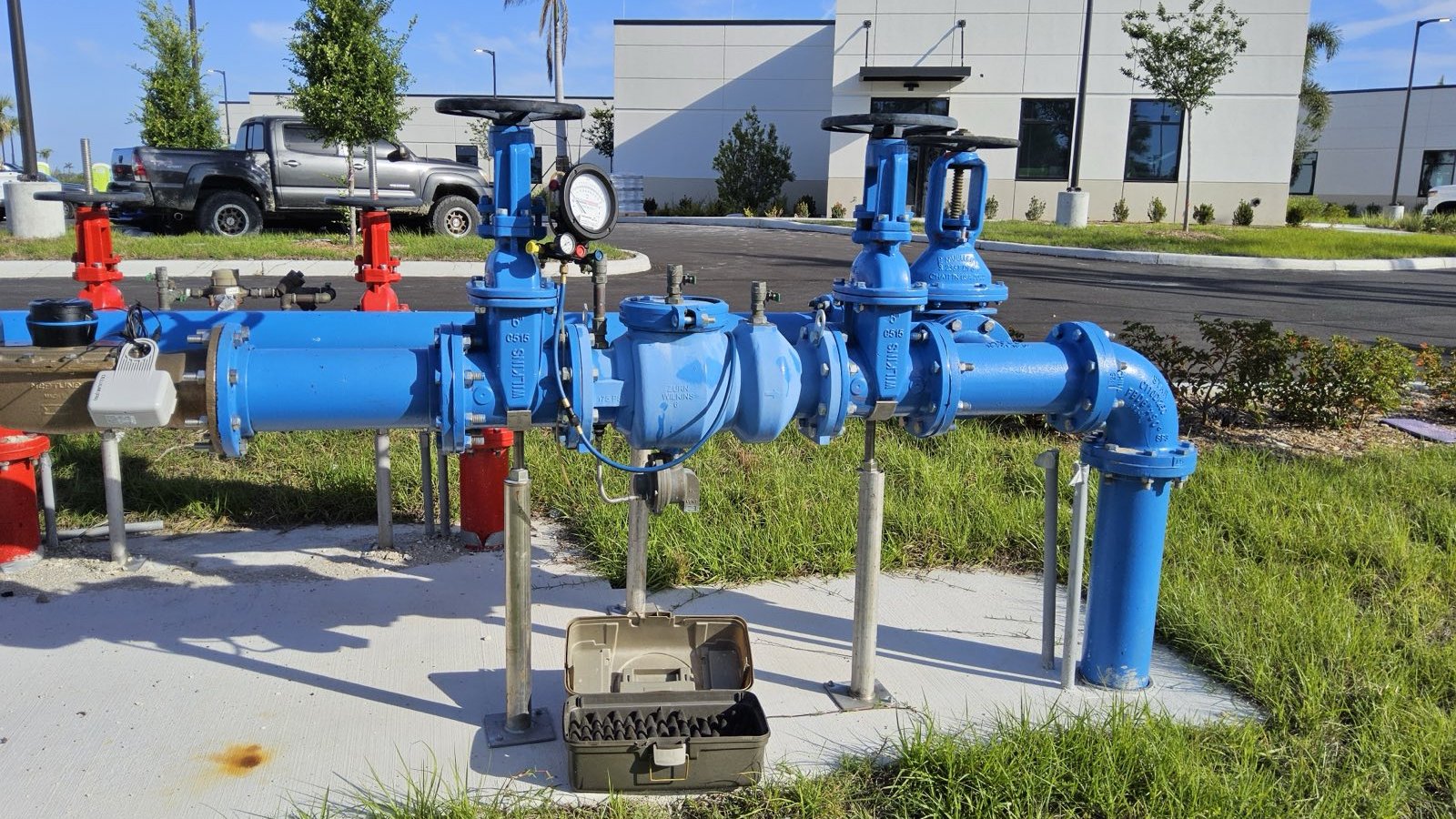
RPZ assemblies show up everywhere a Code-defined high-hazard cross-connection exists. That includes commercial water service (restaurants, medical offices, dental clinics, beauty salons with chemical processing, industrial sites), irrigation systems with chemical injection (fertigation or pesticide injection adds the hazard level), residential pool auto-fill plumbed off the domestic water supply at certain configurations, and any application where the potential contaminant on the property side is dangerous, not just unpleasant. On commercial properties in North Port and Englewood, RPZ assemblies are typically wall-mounted in mechanical rooms, on exterior stucco walls, or in below-grade vaults under parking lots.
What an RPZ does mechanically
An RPZ uses two check valves in series with a relief valve in between. The relief valve discharges water out a port if certain internal pressure conditions are violated (typically, if the differential between the upstream check and the relief zone drops below 2 PSID). That active discharge is what makes RPZ the strongest of the three. It protects against both backsiphonage and full backpressure including from a pressurized contaminated source. The trade-off: RPZ assemblies will occasionally discharge water out the relief port during normal operation if upstream pressure fluctuates, which is why you sometimes see a small puddle under one. That is not a failure. That is the device doing its job.
Florida sizing typical
RPZ sizing ranges from one-inch on small commercial connections up to six-inch on larger industrial water services. Three-quarter-inch RPZ exists but is unusual. Common Charlotte County RPZ models: Wilkins 975XL, Febco 825Y and 860, and Apollo 4A. We do not test certain brands of RPZ that fall outside our regular service inventory.
How the annual RPZ test runs
Thirty to forty-five minutes on site for a typical commercial RPZ, longer on larger assemblies or vault installations. The test runs both check valves and the relief valve individually with the gauge, recording the differential pressure on each. Vault installations add a few minutes for opening the lid and lighting the working space. RPZ assemblies have more failure modes than PVB or DCV because of the relief valve, which is the most common single failure point we see in Charlotte County.
How to tell which backflow preventer is at your property
If you cannot tell from looking at the device, you have three quick paths to an answer.
Visual identification of your backflow preventer
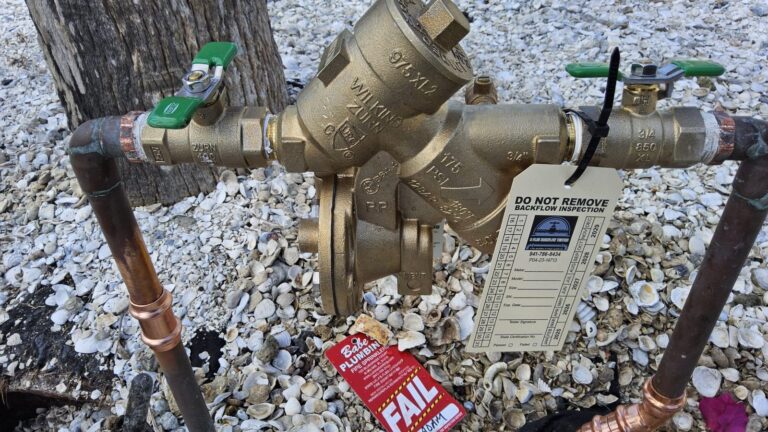
PVBs are taller and skinnier with a vertical bonnet on top. DCVs are horizontal with two check-valve bodies in line. RPZ assemblies are wider in the middle with a visible relief port underneath (sometimes with a brass plug or a drain line attached). Once you have seen one of each up close, you can spot the difference in two seconds. Until then, a phone photo works better than a description.
Where on the property it is likely mounted
- Front-yard irrigation pad with a vertical brass assembly above ground: almost always a PVB.
- Above-ground assembly at the fire-sprinkler riser entry, horizontal: almost always a DCV (or DCDA on commercial fire lines).
- Wall-mounted assembly with a wider middle section, sometimes with a small puddle underneath: almost always an RPZ.
- Below-grade vault with a lid: almost always RPZ or large DCV/DCDA, depending on the application.
What your last utility notice probably says
Both North Port Utilities and Englewood Water District print the device type on the annual notice in most cases. If you have the notice in hand, the device type and serial number are usually on it. If not, snap a phone photo of the device and text it to (941) 786-8434 and we will identify it in under a minute.
Why the device type changes your annual testing process
Three things change with device type, which is why pricing varies and why a tester who specializes in one type and not the others has gaps.
Gauge connection points
PVB has two test ports (one upstream of the check, one between the check and the air inlet). DCV has four test ports (two per check valve). RPZ has four test ports plus a separate connection at the relief valve. More connection points mean more gauge cycles, which is partly why RPZ takes longer to test.
Test duration
Twenty minutes for residential PVB, twenty-five to thirty minutes for DCV, thirty to forty-five for commercial RPZ. The duration is real driving time on a service call. For a quote on your specific device, call (941) 786-8434.
Common failure modes by device type
- PVB failures are usually worn check-valve springs or a sticky air-inlet that does not fully open under low pressure.
- DCV failures are usually worn check-valve springs on one of the two checks, or debris between the seat and the disc on one check.
- RPZ failures are usually worn check-valve springs, debris in the relief valve, or a damaged seat. The relief valve is the most common single failure point.
When any of these fail at the annual test, we identify the failure mode in trade terms on the certified test report. You then hire a separate licensed backflow service contractor to address the failure, and we come back to re-test for re-certification once the work is documented. For the full sequence, see our guide on what to do when your backflow test fails.
Frequently asked questions
Which backflow preventer is best for irrigation?
PVB for standard residential irrigation. The PVB is sized for low-hazard residential cross-connections and is the cheapest of the three to test annually. DCV works for low-hazard HOA irrigation in some cases. RPZ is required if your irrigation system has chemical injection (fertigation, pesticide injection) because that elevates the hazard rating.
Which backflow preventer is required for fire lines in Florida?
DCV or DCDA (Double Check Detector Assembly) is the standard for fire-sprinkler riser protection in Charlotte County. The DCDA variant adds a bypass meter so the utility can detect unusual flow through the fire line. Larger commercial properties may have RPZ on fire lines depending on local Code interpretation, but DCV/DCDA is the typical default.
Can I swap from one backflow preventer type to another?
No. The device type is determined by the Code-defined hazard rating of the cross-connection, not by what the property owner prefers. Swapping from RPZ to DCV on a high-hazard application is a Code violation regardless of whether the DCV passes its annual test. Any device swap is performed by a licensed plumbing contractor under permit.
How do I know if my HOA has DCVs or RPZs?
The annual notice from the water utility names the device type on most accounts. If the HOA has a maintenance log or a prior tester’s report, the device type is on that. Otherwise, a quick site visit identifies the device mix across a portfolio. We do this regularly for HOAs in North Port and Englewood and can name the device type and Code requirement on every assembly in a single visit.
Ready to schedule your annual backflow test?
Call (941) 786-8434 or book your annual backflow test online. Florida BAT #PR14723. We test PVB, DCV, and RPZ on residential, HOA, and commercial properties across North Port and Englewood.
Related reading:
- Charlotte County backflow testing pillar guide
- What is a backflow preventer (homeowner intro)
- What to do when your backflow test fails
- Backflow testing cost in North Port, FL
- Backflow testing cost in Englewood, FL
- Florida backflow test due date guide
- Annual backflow testing service
Industry standards for DCV vs RPZ vs PVB
The DCV vs RPZ vs PVB distinction traces to three separate ASSE engineering standards and to the USC Foundation for Cross-Connection Control field manual. The ASSE 1013 standard covers Reduced Pressure Principle Backflow Preventers (RPZ). The ASSE 1015 standard covers Double Check Valve Assemblies (DCV). The ASSE 1056 standard covers Spill-Resistant Vacuum Breakers (SVB) and ASSE 1020 covers Pressure Vacuum Breakers (PVB). The USC FCCCHR Manual is the field reference that maps each standard to the test procedure crews actually run. Florida DEP recognizes all four ASSE standards as the technical baseline for the state Code.
More for Charlotte County backflow testing customers
Two additional resources from our 2026 testing-only cluster cover scenarios that come up often in conversations with North Port and Englewood property owners.
- Backflow testing near me, Charlotte County guide walks what a backflow testing near me search actually returns, why locally owned matters, and how to verify any tester you call is registered with your specific utility.
- Fire line backflow testing in Florida, commercial guide covers DCV and DCDA fire-sprinkler riser testing, why the Englewood Water District splits the approved-tester list into general and fire-line designations, and the on-site procedure for fire line backflow testing in Florida commercial properties.