Charlotte County Backflow Testing: The Trusted Compliance Guide
If a postcard showed up from North Port Utilities or Englewood Water District telling you your annual Charlotte County backflow testing is due, you probably have three questions. What does this thing actually do? Who is supposed to test it? And what happens if you ignore the notice? Florida law settles all three. We test thousands of these devices a year, only in North Port and Englewood, and this guide walks the whole compliance loop from notice to certificate in plain English. No fluff, no upsell, no pricing games.
This is the long version of “test, file, done.” If you want to skip ahead, the table of contents below jumps you straight to the part you need.
Table of contents
- What Florida backflow testing law requires
- How North Port and Englewood enforce backflow compliance
- The 3 backflow preventer types in Charlotte County homes
- What an annual backflow test looks like on site
- Filing your backflow test report with your utility
- What happens when a backflow device fails
- Why choose a specialist tester over a general plumber
- Service area and scheduling
- Frequently asked questions
What Florida backflow testing law requires
Florida is direct about this. If you have a cross-connection between the public water supply and any other water source on your property, you must have an approved backflow preventer in place and it must be tested every year by a Florida-certified backflow assembly tester.
The annual cycle: every cross-connection, every year
The rule lives in Florida Administrative Code 62-555.360(2). The agency that wrote it (Florida Department of Environmental Protection) delegates day-to-day enforcement to your local water utility. In Charlotte County, that means North Port Utilities and Englewood Water District handle it. The state writes the rule. The utility chases you for the certificate. That split confuses people, but it matters because your re-test deadline comes from your utility, not the state.
A “cross-connection” sounds like industrial jargon, but it is just any spot on your property where contaminated water could (in a worst-case scenario) get sucked back into the clean drinking-water line. Irrigation systems are the most common one in Charlotte County. Fire-sprinkler lines are next. Pool auto-fill lines, soft-water loops, and process water at commercial properties round out the list.
Which devices trigger annual backflow testing
If any of these touch your property, you need annual testing:
- An irrigation system on a separate meter or with a backflow preventer at the connection
- A fire-sprinkler riser fed off the potable water main
- A pool auto-fill plumbed off the domestic water supply
- A soft-water loop or filtration system tied into the main
- A commercial water service feeding food prep, medical, dental, beauty, or industrial equipment
- A separate irrigation meter at any property type, even with no sprinklers running today
That last one catches a lot of people. The meter does not care if your sprinklers are dead. If the meter exists, the device on it gets tested.
Florida Administrative Code 62-555.360(2) in plain English
The Code requires that approved backflow protection be installed and that the device be tested annually by a certified backflow assembly tester (“BAT-certified” in trade shorthand). The certified test report has to be on file with your utility within the testing year. If you let your testing year close without a passing report on file, you are non-compliant. That state-level requirement is why your utility cares enough to chase you with a postcard, then a letter, then (eventually) a shutoff warning.
You can read the full rule at the Florida DEP Cross-Connection Control Program page. The program page links the underlying Code and explains the utility-level delegation.
How North Port and Englewood enforce backflow compliance
Charlotte County is straightforward to work in because only two utilities matter for the residential and small-commercial accounts we test: North Port Utilities (for North Port) and Englewood Water District (for Englewood, Rotonda West, Rotonda Sands, Grove City, Cape Haze, and Manasota Key). Each one runs its compliance calendar a little differently, and a tester who only knows one of them will trip on the other.
North Port Utilities: postcard and portal
North Port Utilities sends customers a notice (typically a postcard or letter) when the annual test is due. The customer is responsible for hiring a certified tester to perform the test and file the report. North Port runs an online Cross-Connection Control portal that registered testers use to file results. Reports from non-registered testers get rejected. A Plus is registered on that portal, which is the only reason we can promise same-day filing for North Port customers. The portal stamps every submission with a real-time timestamp, so your compliance record updates the same business day.
The North Port portal also matters for re-tests after a failure. If your device failed last year and got fixed by a separate licensed backflow service contractor, your new test (the re-test) has to be re-filed in the portal under a separate certified test report. That second filing is what closes the loop on your compliance record.
Englewood Water District: anniversary letter and approved-tester list
Englewood Water District runs a different system. They mail an annual anniversary letter based on the date of your last passing test, and they only accept reports from testers on their published Englewood Water District Backflow Testers list. The list is publicly viewable on the EWD website, and it separates general backflow testers from fire-line backflow testers, which is the detail that catches commercial property owners with fire risers. EWD wants the test report filed per their published instructions (typically by email submission to the address on the testers page). A Plus is on the EWD approved-tester list.
Both utilities give roughly a 30-day grace window past your stated due date, but neither writes that grace into policy in a way that you should plan around. We’ve seen North Port escalate to a certified-mail warning at 60 days past due. EWD typically gives a longer window for residential, shorter for commercial fire-line. Treat the due date on your notice as the actual deadline, not the start of negotiation.
What happens if you ignore the notice
The escalation ladder is roughly the same at both utilities. A reminder. A second notice (sometimes by certified mail). A pre-shutoff warning. An actual water shutoff. Water shutoff is rare in Charlotte County for a missed backflow test, but it is on the books. The more common problem is that an unresolved compliance notice surfaces in a title search when you go to sell the property, and the buyer’s closing attorney puts a hold on the deal until it is cleared.
That title-search trap is why HOAs and property managers care about backflow compliance even when no individual unit owner is panicking. A portfolio with one unresolved notice can complicate every adjacent sale.
For a deeper walk through the timeline of what each notice looks like and your typical grace window, see our Florida backflow test due date guide.
The 3 backflow preventer types in Charlotte County homes
Three device types cover the overwhelming majority of what we test in Charlotte County. If you have a notice and you do not know which type you have, your tester is going to tell you. But knowing in advance helps the conversation.
PVB (Pressure Vacuum Breaker) for irrigation
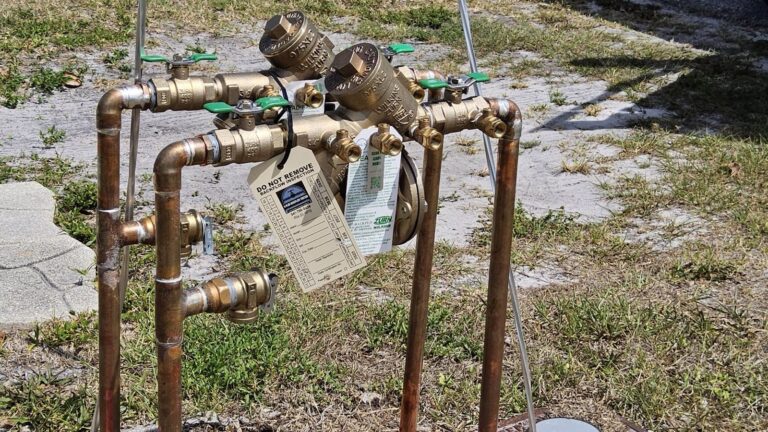
The PVB is the device most Charlotte County homeowners are looking at when they pull up their irrigation meter and see a brass assembly with a bonnet on top. PVBs sit above ground (Code requires them at least 12 inches above the highest sprinkler head), and they protect against backsiphonage on irrigation lines. Wilkins 720A and Febco 765 are common PVB models in our service area. A PVB is the simplest of the three to test, and the test is fast (about 20 minutes on site for most residential PVB jobs).
DCV (Double Check Valve) for fire lines and double-check applications
DCVs (Double Check Valve assemblies) are common on fire-sprinkler risers, low-hazard irrigation applications, and certain commercial water services. They sit either above ground or in a vault, depending on the application. DCVs use two check valves in series, which means each gets tested individually with the gauge. Common models in Charlotte County include Febco 805Y, Apollo 4ALF, and Zurn Wilkins 350. DCV testing takes a bit longer than PVB testing, especially on a fire-line DCDA (Double Check Detector Assembly) where there is also a bypass meter to verify.
RPZ (Reduced Pressure Zone) for commercial and high-hazard
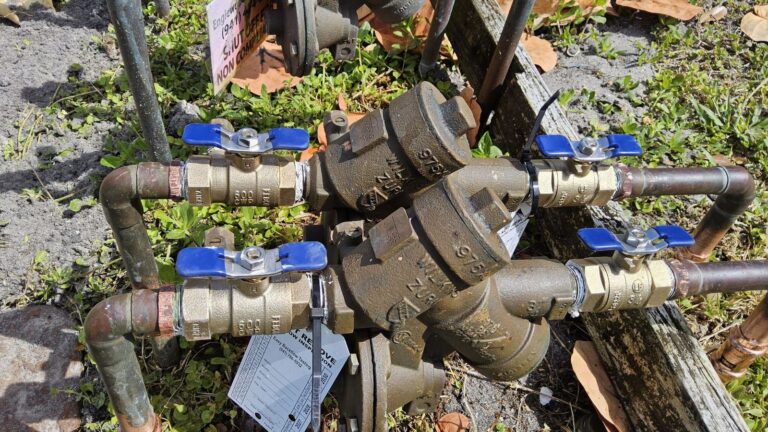
RPZ assemblies (Reduced Pressure Zone backflow preventers) are the heavy lifters. They protect against both backsiphonage and backpressure, which is why they are required for high-hazard applications: commercial water services, medical and dental connections, irrigation systems with chemical injection, process water at industrial sites, and any cross-connection where the potential contaminant is dangerous, not just unpleasant. RPZ assemblies have a relief valve in the middle that discharges water during certain failure conditions, which is why you sometimes see a small puddle under one. Common Charlotte County RPZ models include Wilkins 975XL, Febco 825Y and 860, and Apollo 4A. A typical commercial RPZ test takes about 30 to 45 minutes on site.
If you want a deeper side-by-side on the three types and which one is at your property, we’ve got a longer breakdown coming. For now, the photo of the device on your meter (or the tag attached to the body) tells you the model, and the model tells you the type.
What an annual backflow test looks like on site
The annual backflow test is one of the cheapest, fastest compliance items you will ever schedule. Most residential tests take about twenty minutes on site. The whole process (call, schedule, test, file, certificate to your inbox) takes about a week start to finish on a normal calendar.
About twenty minutes on site
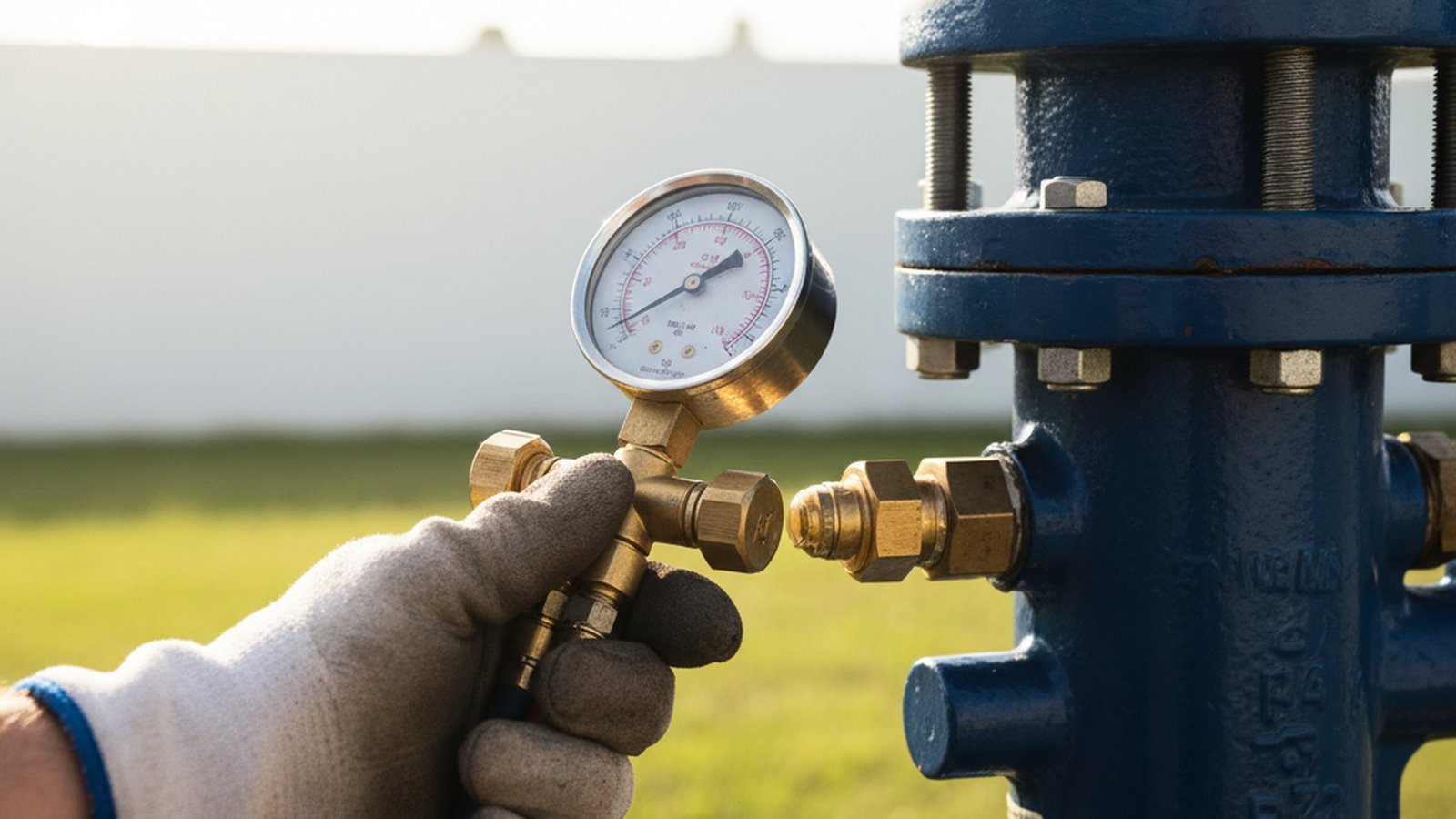
We pull the truck up. We confirm the device, the model, and the meter. We attach a calibrated gauge to the test ports on the assembly. We close shutoffs in sequence, watch the pressure differential across each check valve and the relief valve, and record the readings on the certified test report. We open the device back up. We retest the shutoff function. We write the date, the gauge serial, the BAT certification number (BAT #PR14723), and we sign the report.
We send the signed report to your utility same business day (North Port portal, or EWD per approved-tester instructions). You get a PDF of the signed report by email. We keep a copy on file. Done.
Why you don’t need to be home (most residential)
For most residential PVB and DCV testing, the device is in the front yard or along the side of the house in an open easement. We do not need to enter your home, your garage, or your fenced yard for most jobs. We text 30 minutes before we arrive so you can move the dog or unlock the gate if it is locked. For commercial RPZ in a vault or behind a locked enclosure, we coordinate access with the facility manager during scheduling.
The gauge, the checks, the certificate
The test gauge is a calibrated differential pressure gauge. It reads in PSI. Every gauge has a calibration certificate (ours are calibrated annually), which is what makes the test report defensible to the utility. A “passed” test means every check valve and the relief valve held within Code-acceptable pressure differentials. A “failed” test means one of them did not. The report tells your utility (and you) exactly which check valve or relief valve failed, in case re-test or recertification is needed later.
Filing your backflow test report with your utility
Here is the part that catches more Charlotte County property owners than the test itself. A test that is not filed is, from the utility’s perspective, no test at all. The filing (not the test) is the most common single point of failure in backflow compliance, and it is the reason “I thought my backflow was done” letters arrive months after a homeowner thought they had handled it.
North Port Utilities portal walkthrough
For North Port customers, we file directly through the North Port Utilities Cross-Connection Control portal. Only registered testers can submit to the portal. We log in, select the property by address or account number, enter the device readings and pass/fail status from the signed test report, upload the PDF, and submit. The portal stamps the submission with a real-time timestamp and updates your compliance record the same business day in most cases. If the portal is down or the device is not yet in the system (new install), we use the utility’s backup email submission process so the report still lands on the same business day.
Englewood Water District approved-tester process
For EWD customers, we file per the approved-tester process published on the EWD backflow testers page. That process is typically a same-business-day email submission to the address on the testers page, with the signed PDF report attached. EWD confirms receipt and updates your compliance record. You receive a copy of the signed test by email from us, and a confirmation from EWD on their schedule (usually within one to two business days). Fire-line backflow testing has its own approved-tester designation on the EWD list, and only testers on the fire-line list can file fire-line reports. We carry both designations.
Why the filing (not the test) is where most non-compliance happens
We have lost count of how many “rescue” calls we have run where a homeowner paid a different tester last year, the test ran, the homeowner got a signed certificate, and the report never made it to the utility. The certificate in your hand is not the compliance record. The compliance record sits in the utility’s system. If your tester does not file the report or files it with the wrong utility or under an old account, your record stays open and you stay non-compliant until somebody re-files it. That re-filing usually means re-testing too, because the original test is more than 30 days stale.
For a deeper walk-through of how each utility handles the filing step, the formats they accept, and what to do if your filing got rejected, see our Florida backflow test report filing guide. It covers both utilities side by side.
What happens when a backflow device fails
A failed annual backflow test is not an emergency. It is paperwork plus a sequence. The sequence has four steps and three different parties (you, your service contractor, us as your tester). Knowing the sequence in advance keeps a fail from turning into a crisis.
Your written report identifies the failure mode
The certified test report from us identifies exactly which part of the device failed. The most common failure modes we see in Charlotte County are worn check-valve springs (the rubber on the spring-loaded check has deteriorated and the seal no longer holds), debris in the relief valve (a piece of grit, sediment, or pipe scale is keeping the relief from seating cleanly), and damaged rubber seats (the seat the check valve closes against is nicked, eroded, or cracked). Less common but more serious failures include cracked bodies (the brass assembly itself has a crack from freezing or impact) and severe corrosion (the body is structurally compromised).
The report names the failure in trade terms (“first check failed,” “relief valve discharge above 2 PSID,” etc.) so the licensed backflow service contractor you hire next can order the right parts and arrive ready to work.
You hire a licensed backflow service contractor to address the issue
A Plus is a backflow testing service. We test, we report, we file, and we re-test. We do not perform the corrective work on a failed device. That work goes to a separate licensed backflow service contractor (often a plumbing contractor with the right licensing). We do not name specific contractors because endorsing a third party creates liability, but a search for “Florida licensed backflow service contractor” in your area will surface options. Ask for proof of license and proof of insurance before they arrive.
We come back and re-test for certification once the work is done
Once your contractor has addressed the failure and given you documentation (an invoice or work order describing the parts swapped and the work performed), you call us back to schedule the re-test. The re-test follows the same on-site procedure as the original annual test (gauge attached, readings recorded, pass/fail confirmed). When the re-test passes, we file a new certified test report with your utility and your compliance record updates. The whole sequence (failed test, contractor work, re-test, re-filing) typically resolves in one to two weeks in Charlotte County.
If you want the full step-by-step, see our guide on what happens when your backflow test fails (coming soon as part of this rebuild). It covers the call sequence, what your contractor will look at, the typical re-test window, and how the re-filing handles the closed loop.
Important: A Plus is testing-only
We retired our corrective-work offerings to focus on a single service. That keeps the on-site visit fast, the schedule predictable, and the report defensible. Customers who appreciate a specialist who does one thing well are the customers we serve best.
Why choose a specialist tester over a general plumber
Backflow testing is a specialist trade with a specialist certification (BAT, Backflow Assembly Tester). Some general plumbers carry the certification as a side service. We do this as our only service. The practical difference shows up in three places.
Specialist vs side-service
A plumber who runs backflow tests as a side service may show up with a gauge that has not been calibrated in twelve months (Code requires annual calibration), may not be registered on your utility’s portal, and may not know the specific filing format your utility wants. We calibrate our gauges annually, we are registered on both Charlotte County portals (North Port + EWD), and we file every test the same business day.
Owner-operator vs subcontracted
A Plus is owner-operated. Scott Eason (BAT #PR14723) personally runs every test. There is no call center, no dispatcher routing the job to a sub, and no rotating tech who does not know your property. You get the same tester this year that you got last year, which means we already know where the device is, how access works, and which utility filing applies.
Filing speed and portal registration
Same-business-day filing is not a marketing line. It is what registered testers do because the portal accepts the submission in real time. If your previous tester said “the report is in the mail” or “we will file it Monday,” they probably were not portal-registered. Filing speed matters when your due date is days away, and it matters more when your record is already in arrears.
Service area and scheduling
We work only in Charlotte County, and only in two cities: North Port and Englewood. That tight focus is what lets us be fast, file same-day, and personally know the neighborhoods, the irrigation patterns, and the device mix.
North Port neighborhoods we cover
We cover the full North Port Utilities service area, including Heron Creek, Sabal Trace, Lakeside Plantation, Talon Bay, Villas at Charleston Park, Cocoplum, Bobcat Trail, Heron Creek Golf and Country Club, and every ZIP across the North Port grid. If your address is inside North Port city limits, we work there. For more on city-specific scheduling and what the North Port Utilities portal experience looks like, see our North Port backflow testing page.
Englewood Water District coverage
We cover the full Englewood Water District service area, which includes Englewood proper, Rotonda West, Rotonda Sands, Grove City, Cape Haze, and Manasota Key. EWD coverage is broader than just the city of Englewood, which is why some Cape Haze and Manasota Key owners are confused about which utility they are on. If your water bill comes from EWD, you are in our service area. For city-specific details and the EWD approved-tester confirmation, see our Englewood backflow testing page.
For the full county coverage map and how the two utilities split the territory, see our Charlotte County service area page.
How to book and what to have ready
Booking is a phone call or a short form. When you call (941) 786-8434, we ask three things: your address, the type of device you have (or “I do not know”), and your utility name (or “I do not know”). With those three answers (even if two of them are “I do not know”), we can quote a window, confirm the device match, and schedule the test. We text 30 minutes before we arrive on the day of the visit. You get the signed report by email the same business day. The compliance record at your utility updates the same business day in most cases.
Frequently asked questions
How much does Charlotte County backflow testing cost?
Pricing varies by device type, device size, access, and a few smaller factors. We do not publish a flat number on the website because the right number depends on your property. Call (941) 786-8434 or request a quote and we will quote yours in two minutes.
How long does an annual backflow test take?
About twenty minutes on site for most residential PVB and DCV testing. Commercial RPZ testing runs about 30 to 45 minutes depending on assembly size and access. The whole process (call, schedule, test, filed report, certificate in your inbox) typically takes about a week start to finish on a normal calendar.
Do I have to be home for the backflow test?
Most residential PVB and DCV tests do not require you to be home. The device is in the front yard or along the side of the house in an open easement. We text 30 minutes before we arrive so you can unlock a gate or move a dog if needed. Commercial RPZ in a vault or behind a locked enclosure needs facility access coordinated during scheduling.
What if my backflow device fails the test?
Your written report identifies the failure mode (worn check-valve springs, debris in the relief valve, damaged seats). You hire a separate licensed backflow service contractor to address the issue. We come back and re-test for re-certification once the work is documented. The re-test gets filed with your utility same business day and your compliance record updates. We do not perform the corrective work ourselves. We test, report, file, and re-test.
How do I know if I am on North Port Utilities or Englewood Water District?
The utility name is at the top of your water bill. If your address is inside North Port city limits, you are on North Port Utilities. Englewood Water District covers Englewood proper, Rotonda West, Rotonda Sands, Grove City, Cape Haze, and Manasota Key. Some Cape Haze and Manasota Key addresses are confusing, so if in doubt, call your utility billing desk or call us at (941) 786-8434 and we will tell you in 60 seconds.
Ready to schedule your annual Charlotte County backflow test?
Call (941) 786-8434 or book your annual backflow test online. One tester, one truck, one phone number. Florida BAT #PR14723.
Want more detail on a specific part of the compliance loop? Start here:
- Annual backflow testing service details
- North Port backflow testing
- Englewood backflow testing
- Florida backflow test due date guide
- How to file your backflow test report in Florida
- Charlotte County service area
- About A Plus Backflow Testing
Authoritative resources for Charlotte County backflow testing
Charlotte County backflow testing rests on a Florida-specific Code (FAC 62-555.360(2)) sitting on top of a national industry standard. Customers who want to verify the technical baseline can pull from two authoritative industry references in addition to the state rule.
The ASSE 1015 standard for Double Check Valve Assemblies is the consensus engineering standard most Florida utilities defer to when they specify the test procedure for DCV-style devices. The USC Foundation for Cross-Connection Control and Hydraulic Research (FCCCHR) Manual is the field reference Charlotte County backflow testing crews carry in the truck for assembly identification and test-port procedure. Both sources are recognized by the Florida Department of Environmental Protection.
How Charlotte County backflow testing differs from neighboring counties
Charlotte County backflow testing has two utility-specific quirks the surrounding Sarasota and Lee County backflow testing programs do not share. North Port Utilities runs a real-time portal that updates the compliance record same business day. Englewood Water District publishes a separate fire-line approved-tester designation. A tester registered for one is not automatically registered for the other. Knowing both is the operational baseline for Charlotte County backflow testing customers who own commercial property with mixed device types.
Why Charlotte County backflow testing matters for property transfers
An unresolved Charlotte County backflow testing compliance notice surfaces in title-search reports during property sales. Closing attorneys flag the open compliance item and the deal stalls until it clears. Property owners selling a North Port or Englewood property should confirm Charlotte County backflow testing is current 30 to 60 days before listing. We see this pattern at least once a month in the rotation.
More for Charlotte County backflow testing customers
Two additional resources from our 2026 testing-only cluster cover scenarios that come up often in conversations with North Port and Englewood property owners.
- Backflow testing near me, Charlotte County guide walks what a backflow testing near me search actually returns, why locally owned matters, and how to verify any tester you call is registered with your specific utility.
- Fire line backflow testing in Florida, commercial guide covers DCV and DCDA fire-sprinkler riser testing, why the Englewood Water District splits the approved-tester list into general and fire-line designations, and the on-site procedure for fire line backflow testing in Florida commercial properties.