What Is a Backflow Preventer? A Simple 2026 Florida Guide
What is a backflow preventer? It is the brass or stainless device on your irrigation line, fire-sprinkler riser, or commercial water service that keeps dirty water from getting sucked or pushed back into the clean drinking-water supply. Florida law requires it on every cross-connection in the state. If you live in North Port or Englewood and you have one in the front yard, on the side of the house, or in a vault near the meter, this guide walks the whole topic in plain English.
No jargon for the sake of jargon. Just the answer to the question and the next two questions after it.
Table of contents
- What a backflow preventer does in one sentence
- How to tell if you have a backflow preventer
- The 3 backflow preventer types in Florida homes
- Why a backflow preventer gets tested every year
- What an annual backflow test involves
- What happens when a backflow device fails its test
- Frequently asked questions
What a backflow preventer does in one sentence
A backflow preventer is a one-way mechanical valve assembly that protects the clean potable water in your home from getting contaminated by water on the other side of your meter. It does one job: keep clean water flowing in, keep everything else from sneaking back the other way.
The clean-water-out, dirty-water-stays-out problem
Picture this. Your irrigation system is running. A water main two streets over has a break, and the pressure in the public supply drops fast. For a moment, water on your property (sitting in the irrigation line, maybe touching grass, fertilizer, or who knows what) gets pulled backwards toward the lower pressure. Without a backflow preventer, that water flows back into the clean supply and into your neighbor’s faucet. With a backflow preventer in place, the check valves slam shut, the relief valve opens if needed, and nothing flows backward. Same idea for fire-sprinkler lines, pool auto-fills, soft-water loops, and any other cross-connection where water on the property could touch something the drinking-water side should never see.
Why Florida law cares
Cross-connection control is a public-health rule. One contaminated property in a neighborhood can affect everyone on the same water main. Florida codified the requirement in Florida Administrative Code 62-555.360(2), which the Florida Department of Environmental Protection administers. Day-to-day enforcement is delegated to your local water utility (North Port Utilities or Englewood Water District in Charlotte County). That is why you get the notice from your utility, not the state.
The EPA cross-connection control manual (federal background reading, not the enforced rule in Florida) explains the broader public-health logic.
How to tell if you have a backflow preventer
You almost certainly have one if you live in Florida and any of the following are true at your property: a separate irrigation meter (with or without working sprinklers), an in-ground sprinkler system, a fire-sprinkler riser, a pool auto-fill line plumbed to the domestic supply, or a commercial water service feeding food prep, medical, dental, or industrial equipment.
Common locations on a Florida property
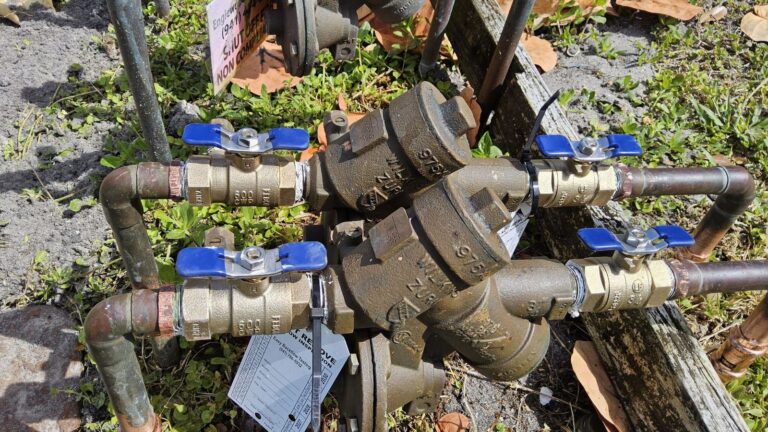
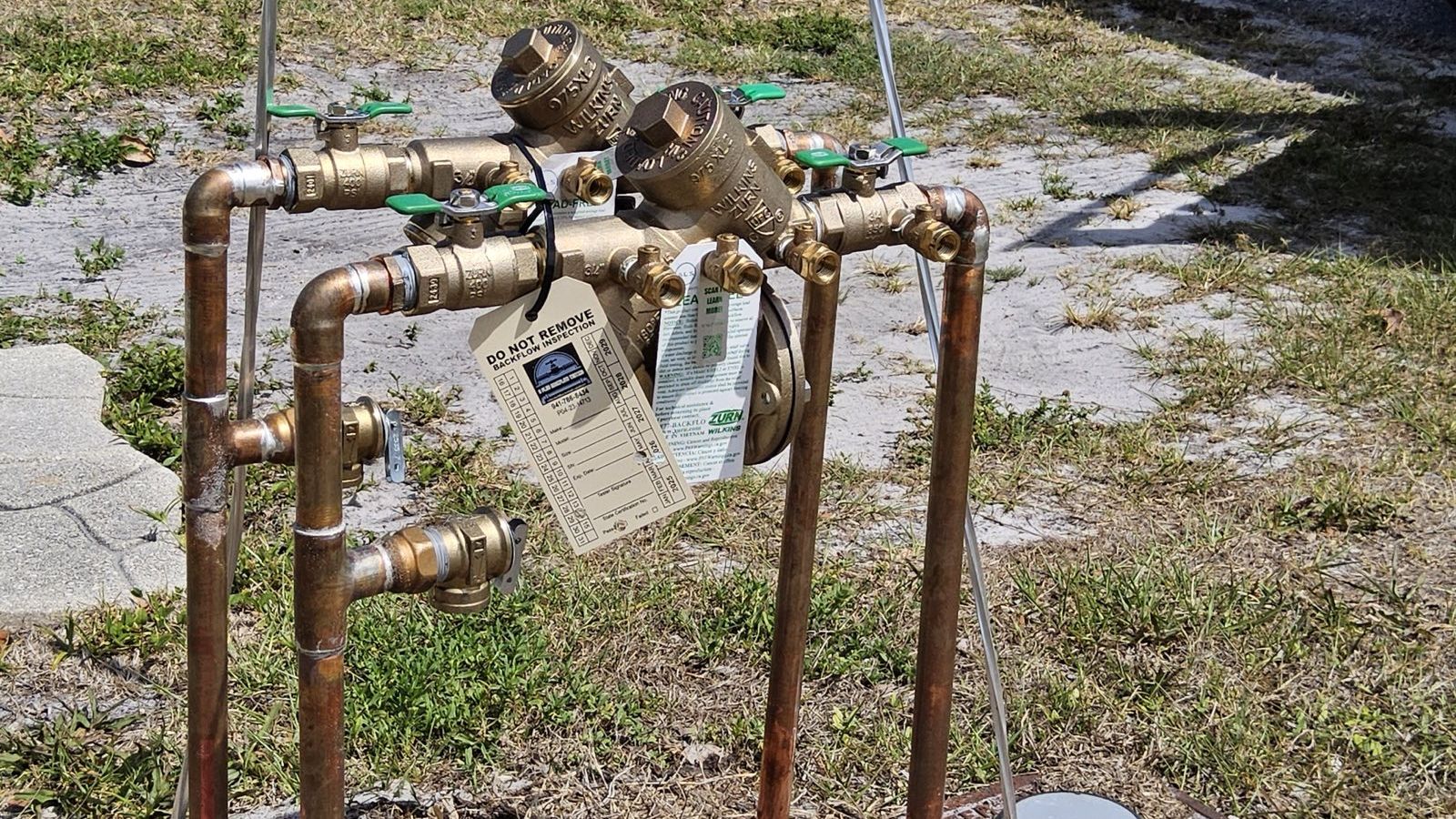
For a typical Charlotte County home with an irrigation system, the backflow preventer sits above ground (Code requires it at least 12 inches above the highest sprinkler head), usually within a few feet of the irrigation meter. Look for a brass or stainless assembly with one or two test ports (small brass plugs about the size of a fingertip) sticking out the sides. Color cues: most residential PVBs have a blue or green bonnet on top. RPZ assemblies have a fatter middle section with a relief port underneath. Commercial properties may have the device in a vault below ground or behind a locked enclosure.
What it looks like (and what to send if you do not know)
If you cannot tell what you have, snap a photo of the device with your phone and text it to (941) 786-8434. We will tell you the type and the likely model in under a minute. The model name is usually stamped on the body in small letters (Wilkins, Febco, Apollo, Zurn are the most common manufacturers we test on in Charlotte County).
The 3 backflow preventer types in Florida homes
Three device types cover the overwhelming majority of what gets installed on Florida residential and small-commercial properties. The type changes the test cost, the test duration, and the typical failure modes.
PVB (Pressure Vacuum Breaker) for irrigation
The PVB is the most common backflow preventer at Florida residential properties. It sits above ground next to the irrigation meter. PVBs protect against backsiphonage (water getting pulled backward by a pressure drop) but not against backpressure. That is fine for irrigation because irrigation lines do not push water backward under pressure. Common models in our service area: Wilkins 720A, Febco 765, and Apollo 4ALF in PVB configuration. PVB testing is fast, about twenty minutes on site for a typical residential job.
DCV (Double Check Valve) for fire lines and double-check applications
DCVs (Double Check Valve assemblies) use two check valves in series instead of a single check plus relief valve. They protect against both backsiphonage and low-pressure backpressure, which makes them the standard for fire-sprinkler risers, low-hazard irrigation, and certain commercial applications. Fire-line DCDA assemblies (Double Check Detector Assemblies) add a bypass meter so the utility can detect any unusual flow through the fire line. Common Charlotte County models: Febco 805Y, Apollo 4ALF in DCV configuration, and Zurn Wilkins 350.
RPZ (Reduced Pressure Zone) for commercial and high-hazard
RPZ assemblies are the most protective of the three. They use two check valves with a relief valve in between, which means they protect against both backsiphonage and serious backpressure, and they actively discharge water out the relief if any contamination tries to push back. RPZ is required for high-hazard applications: commercial water service, medical or dental connections, irrigation with chemical injection, process water at industrial sites, and any cross-connection where the potential contaminant is dangerous. Common Charlotte County models: Wilkins 975XL, Febco 825Y and 860, Apollo 4A. RPZ testing takes a bit longer than PVB or DCV, typically 30 to 45 minutes on site.
For a deeper side-by-side on which of the three is at your property and why it matters for testing, see our DCV vs RPZ vs PVB comparison (coming soon).
Why a backflow preventer gets tested every year
A backflow preventer is a mechanical device with rubber seals, spring-loaded check valves, and (for RPZ) a relief valve. All of those wear over time. Once a year is the schedule Florida picked because annual testing catches wear before it becomes a public-health failure.
Internal seals and check valves wear out
The two main wear items on most backflow preventers are the rubber check valve seals (which can deteriorate from chlorinated water and Florida heat) and the springs that load each check valve (which can lose tension over time). Both are normal wear. Annual testing identifies the wear before the device starts leaking or fails to close fully.
Florida Administrative Code 62-555
The state rule that drives the annual testing requirement is FAC 62-555.360(2). The rule says approved backflow protection has to be installed where required, and the device has to be tested annually by a BAT-certified tester (Backflow Assembly Tester, the trade certification). The certified test report has to be filed with your water utility within the testing year. If your testing year closes without a passing report on file, you are non-compliant.
For more on what your annual due-date notice means and what your grace window actually looks like, see our Florida backflow test due date guide.
What an annual backflow test involves
The annual backflow test is one of the simplest scheduled compliance items you will ever book. Most residential tests take about twenty minutes on site.
About twenty minutes on site
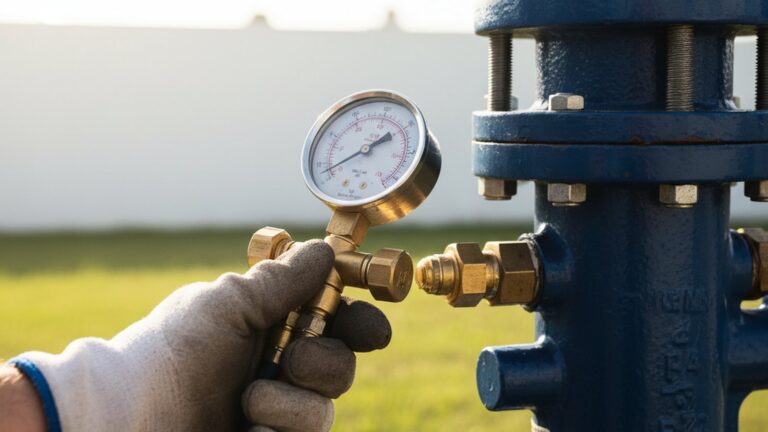
We pull up to your property. We confirm the device, model, and meter. We attach a calibrated differential pressure gauge to the test ports on the assembly. We close shutoffs in sequence, watch the readings as each check valve and (on an RPZ) the relief valve goes through its cycle, and record the results on a certified test report. We open the device back up, retest the shutoff function, sign the report, and email you a PDF the same business day.
You do not have to be home for most residential tests
PVB and DCV devices in open easements (which describes most Florida residential irrigation backflow preventers) do not need you to be home for the test. The device is in the front yard or along the side of the house. We text 30 minutes before we arrive so you can unlock a gate or move a dog if needed. Commercial RPZ in a vault or behind a locked enclosure needs facility access coordinated during scheduling.
What the certificate looks like
The certified test report (sometimes called the certificate) lists your property address, the device location, the model and serial number, the gauge serial number, the BAT certification number of the tester (BAT #PR14723 for our tests), the date, the readings for each check valve and relief valve, and the pass/fail status. We send you the PDF same business day, file the original with your utility (North Port Utilities portal or EWD approved-tester submission), and keep a copy on file.
What happens when a backflow device fails its test
A failed annual backflow test is not an emergency. It is paperwork plus a sequence. The sequence involves three parties (you, a licensed backflow service contractor, and us as your tester).
Your written report identifies the failure mode
The certified test report names the failure in trade terms. The three most common failure modes we see in Charlotte County are worn check-valve springs (the spring loading on a check valve has lost tension), debris in the relief valve (sediment or pipe scale is keeping the relief from seating cleanly), and damaged rubber seats (the seat surface the check valve closes against is nicked or cracked). Less common but more serious failures include cracked bodies (from freezing or impact) and severe corrosion.
You hire a licensed backflow service contractor
The corrective work goes to a separate licensed backflow service contractor. We do not perform corrective work on failed devices. Our service is testing, reporting, filing, and re-testing. We do not name specific contractors because endorsing a third party creates liability, but a search for “Florida licensed backflow service contractor” will surface options. Ask for proof of license and proof of insurance before any work starts.
We come back and re-test for re-certification
Once your contractor has addressed the failure and given you documentation, you call us back to schedule the re-test. The re-test follows the same on-site procedure as the annual test. When it passes, we file a new certified test report with your utility and your compliance record updates the same business day.
For the full step-by-step on the failed-test sequence, see our guide on what happens when your backflow test fails (coming soon).
Frequently asked questions
Do I need a backflow preventer if I do not have irrigation?
You may still have one. Pool auto-fills, soft-water loops, separate irrigation meters with no active sprinklers, and certain commercial water services all trigger the requirement. The easiest check is to walk the property and look for a brass or stainless assembly near the meter. If you find one, it gets tested annually.
Can I test the backflow preventer myself?
No. Florida requires the test to be performed by a BAT-certified tester using a calibrated gauge. The test report has to be filed with your utility under the certified tester’s identification. A homeowner-submitted report gets rejected.
How much does annual backflow testing cost in North Port or Englewood?
Pricing varies by device type, device size, and access. We do not publish a flat number because the right number depends on your property. Call (941) 786-8434 or request a quote for yours in two minutes.
Who is responsible for backflow testing, me or the utility?
You are. The utility owns the requirement, but the property owner schedules the test, pays the certified tester, and is the party on the compliance record. The utility chases you with notices until the certified test report is filed.
Ready to schedule your annual backflow test?
Call (941) 786-8434 or book your annual backflow test online. Florida BAT #PR14723. One tester, one truck, one straight answer.
Want to dig deeper? Start here:
- Charlotte County backflow testing pillar guide
- DCV vs RPZ vs PVB device comparison
- Annual backflow testing service
- North Port backflow testing
- Englewood backflow testing
- Florida backflow test due date
Industry references on backflow preventer testing
Three additional authoritative references for Florida property owners who want to verify the technical baseline of what a backflow preventer is and how the annual test works.
The USC Foundation for Cross-Connection Control and Hydraulic Research publishes the field-standard reference manual used by certified testers across the United States for device identification and test-port procedure. The ASSE 1013 standard for Reduced Pressure Principle Backflow Preventers is the engineering standard for RPZ assemblies. The ASSE 1015 standard for Double Check Valve Assemblies covers DCV testing. These industry references sit underneath the Florida-specific Code that drives the annual test requirement.
More for Charlotte County backflow testing customers
Two additional resources from our 2026 testing-only cluster cover scenarios that come up often in conversations with North Port and Englewood property owners.
- Backflow testing near me, Charlotte County guide walks what a backflow testing near me search actually returns, why locally owned matters, and how to verify any tester you call is registered with your specific utility.
- Fire line backflow testing in Florida, commercial guide covers DCV and DCDA fire-sprinkler riser testing, why the Englewood Water District splits the approved-tester list into general and fire-line designations, and the on-site procedure for fire line backflow testing in Florida commercial properties.