What to Do When Your Backflow Test Fails: A Trusted Florida 4-Step Plan
What to do when your backflow test fails is a question that lands in your inbox or your hand right after a tester signs the certificate marked FAILED. The short answer is that a failed backflow test is not an emergency. It is paperwork plus a sequence. The sequence has four steps and three different parties (you, a licensed backflow service contractor, and us as your certified tester). If you live in North Port or Englewood and you got a fail today, this guide walks the whole path from notice to re-certification.
No panic, no shortcuts. Just the order things happen in and who owns each step.
Table of contents
- What a failed backflow test actually means
- The 4-step backflow recovery process in Florida
- Common backflow failure modes identified in your report
- How long do you have to re-certify after a failed backflow test?
- How to pick a licensed backflow service contractor
- What the backflow re-test visit looks like
- Frequently asked questions
What a failed backflow test actually means
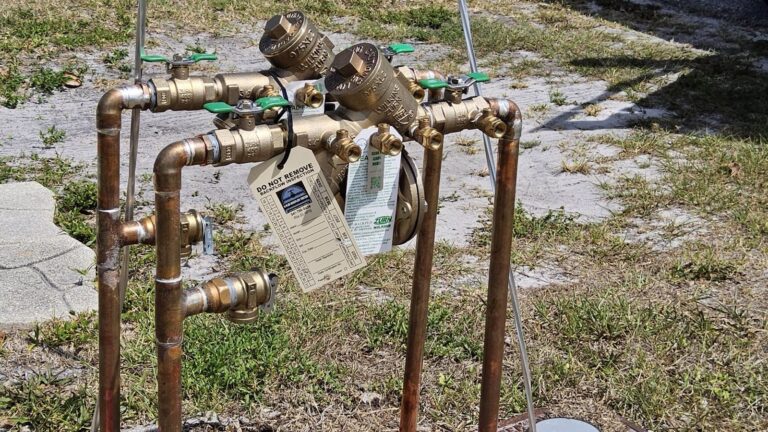
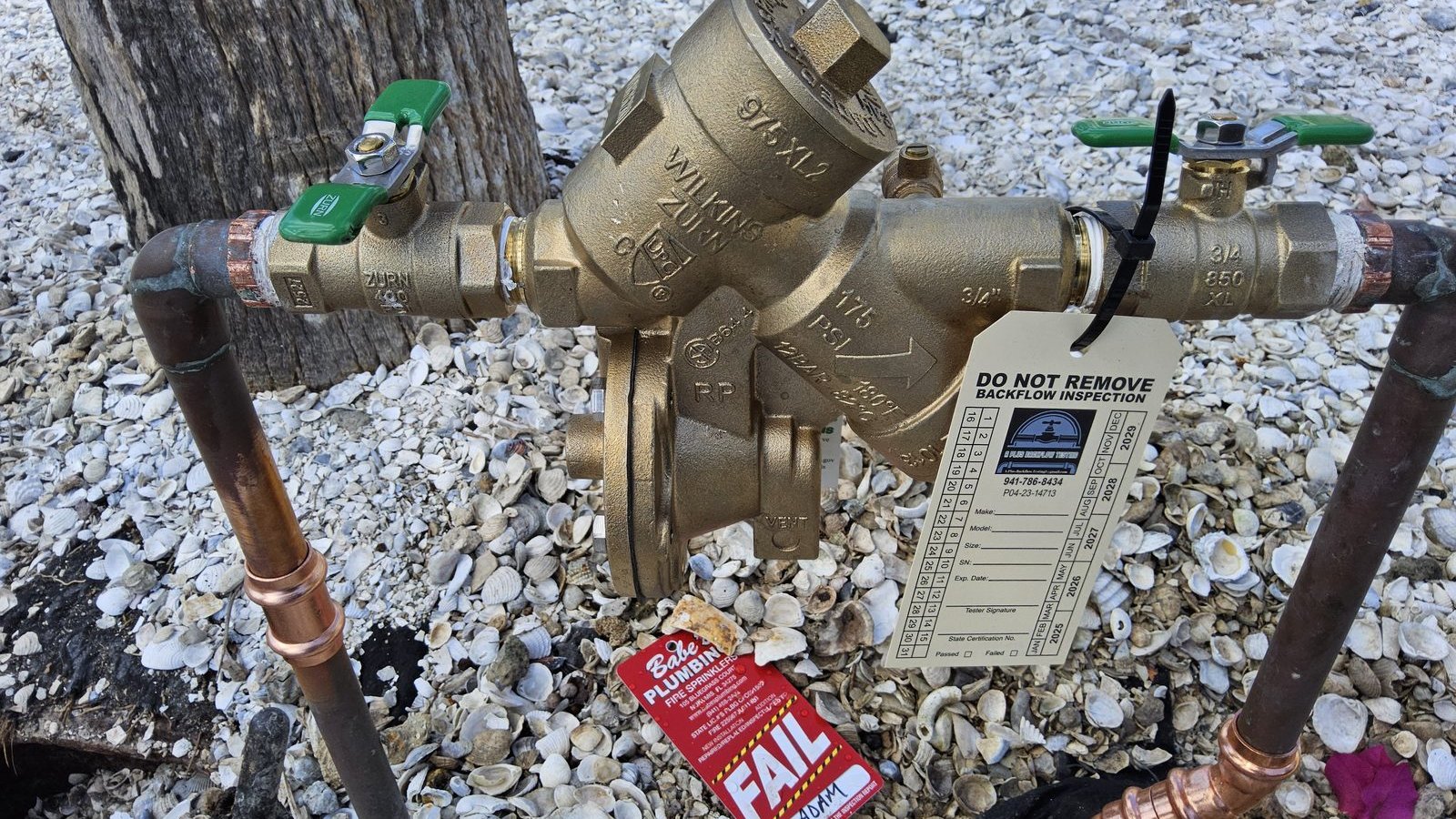
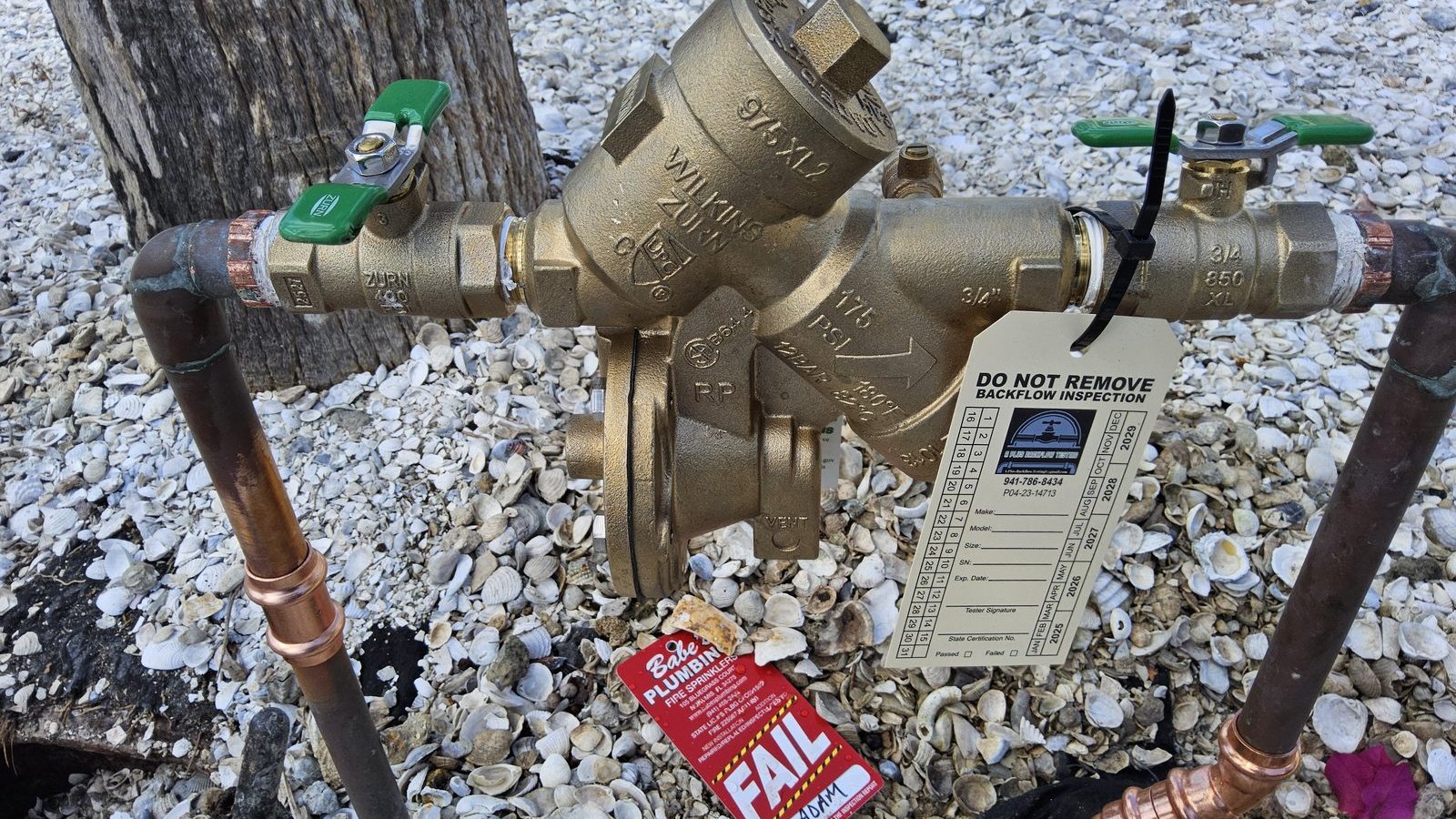
A failed annual test means one or more of the internal components on your backflow preventer did not hold within Code-acceptable pressure differentials when the certified tester ran the gauge. It does not mean your drinking water is contaminated right now. It does not mean your device is destroyed. It means a wear item (typically a spring, a seat, or a relief valve) is past its useful life, and the device cannot be certified as fully protective until the wear item is addressed.
Florida cares about this because cross-connection control is a public-health rule. An uncertified backflow preventer is, from the state’s and the utility’s perspective, the same as no protection at all. That is why your North Port Utilities or Englewood Water District record cannot show a passing certified test report until the device is brought back into spec.
The good news: in Charlotte County, a typical failed annual test resolves in one to two weeks. Most failures are fixable. Some require a full device swap, but those are the minority. Either way, the path forward is the four-step plan below.
For the broader compliance picture (what Florida requires, how each Charlotte County utility enforces it, and what to expect during an annual test), see our Charlotte County backflow testing pillar guide.
The 4-step backflow recovery process in Florida
Knowing the sequence in advance is what keeps a fail from turning into a crisis. Here is the four-step path from a failed test to a clean compliance record.
Step 1: Your written report identifies the failure mode
The certified test report we hand you (and file with your utility) names the failure in trade terms. The report is not vague. It will say something like “first check failed to hold differential pressure above 1 PSID” or “relief valve discharged at 2 PSID below the acceptable threshold.” That precise language is what your licensed backflow service contractor needs to order parts and arrive ready to work. The Backflow Assembly Tester certification (BAT, in our case BAT #PR14723) is the credential that makes the report defensible at the utility level.
Step 2: You hire a licensed backflow service contractor
Step 2 is on you. A Plus does not perform the corrective work on failed devices. Our service is testing, certified test reporting, utility filing, and re-testing for re-certification after the corrective work is done. The corrective work itself goes to a separate licensed backflow service contractor (often a plumbing contractor with the right Florida backflow service license).
We do not name specific contractors because endorsing a third party creates liability. A search for “Florida licensed backflow service contractor” in your area will surface options. When you call one, ask three things up front: are you currently licensed and insured for backflow service in Florida; can you address the specific failure mode named in my report (read them the line); and can you give me a written estimate before work starts.
Step 3: The contractor addresses the issue and gives you documentation
Your contractor arrives, opens the device, addresses the failure (most common: spring swap, seat dressing, relief valve cleaning), and gives you an invoice or work order documenting the parts swapped and the work performed. That documentation is what you hand to us when you call to schedule the re-test. The documentation also matters if you ever need to show a future tester or utility auditor what was done.
Step 4: We come back and re-test, then re-file with your utility
You call (941) 786-8434 to schedule the re-test. We come back to the same property, run the gauge through the same on-site procedure as your original annual test, and confirm the device now holds within Code-acceptable pressure differentials. When the re-test passes, we file a new certified test report with your utility (North Port Utilities portal or Englewood Water District approved-tester submission), and your compliance record updates the same business day in most cases. The whole loop typically closes one to two weeks from the failed test.
For the deep dive on the certified test report itself and what each section means, see our how to file your backflow test report in Florida guide.
Common backflow failure modes identified in your report
Three failure modes account for the vast majority of failed annual tests we run in Charlotte County. Knowing what is on the typical list helps you have a productive conversation with your contractor.
Worn check-valve springs
The spring loading on a check valve loses tension over time. When that happens, the check no longer closes fully under low pressure, and the differential reading on the gauge fails. This is the single most common failure mode we see in Charlotte County, and it is also the cheapest and fastest for a contractor to address. A spring kit is a standard inventory item for licensed backflow service contractors.
Debris in the relief valve
On RPZ assemblies, the relief valve is the safety device that discharges water out a port if certain internal conditions are met. A small piece of grit, sediment, or pipe scale lodged in the relief seat can keep it from closing cleanly, which shows up as relief valve discharge above the acceptable threshold on the test. Addressing it is usually a matter of opening the relief, cleaning it, and reseating. A clean-and-reseat is a same-visit job for most contractors.
Cracked body or corroded housing
The most serious failure mode is a cracked body or severely corroded housing on the assembly itself. Florida heat and the occasional freeze event do not generally crack brass, but impact damage (a mower, a kid’s bike, a falling branch) can. Severe corrosion typically comes from improper drainage or constant standing water around the assembly. When the body itself is compromised, the device gets fully swapped out for a new one (and the contractor pulls a plumbing permit for the swap when required). That is a longer scope of work than a spring swap or relief clean.
If you want to know which device type you have and which failure modes are typical for it, see our DCV vs RPZ vs PVB backflow preventer comparison (coming soon as part of this rebuild package).
How long do you have to re-certify after a failed backflow test?
The answer depends on which Charlotte County utility you are on and how recently your testing year closed.
Charlotte County grace window
Both North Port Utilities and Englewood Water District generally give about a 30-day window past your stated due date before escalating to a stronger notice. Neither writes that grace into formal policy in a way you should plan around. The right approach is to schedule the corrective work and the re-test in the same week, not in the same month.
If your failed test came in well before your annual due date, you have more time. If your failed test came after your due date had already passed (which happens when a homeowner waited on the annual notice), the clock is already ticking and a same-week re-test is the safest path.
What happens if you blow past the deadline
Past 30 days, you can expect a second notice (sometimes by certified mail). Past 60 to 90 days, you may see a pre-shutoff warning. Actual water shutoffs for missed backflow testing are rare in Charlotte County but on the books. The more common consequence is that an unresolved compliance notice surfaces in a title search when you go to sell the property, and the buyer’s closing attorney puts a hold on the deal until it is cleared.
For more on what each utility’s notice escalation looks like and how to read your due date, see our Florida backflow test due date guide.
How to pick a licensed backflow service contractor
The contractor you call for step 2 is a separate trade from us. Picking a good one is the single biggest variable in how fast and how cleanly your failed test resolves.
Three questions to ask before they show up
Ask these on the first phone call:
- Are you currently licensed and insured for backflow service in Florida? (Yes, with a license number they can give you on the spot.)
- Can you address [name the specific failure mode from your report]? (They should be able to answer cleanly without you supplying the parts list.)
- Can you give me a written estimate before work starts? (A written estimate before work starts is a standard practice for trustworthy contractors.)
Why we do not recommend specific contractors by name
A Plus does not maintain a published recommended-contractor list. Endorsing a specific third party creates liability if their work fails, their insurance lapses, or they go out of business. A neutral search and the three questions above will get you a competent contractor in Charlotte County without putting us between you and them.
Once it is fixed, we come back the same week in most cases
Re-test scheduling is usually fast on our end. If you call us with the contractor’s documentation in hand by Tuesday, we can typically be on site for the re-test by Thursday or Friday of the same week. Peak season (typically March through May in Charlotte County) runs a touch longer.
What the backflow re-test visit looks like
The re-test visit is the mirror image of your original annual test. Same on-site procedure, same gauge, same paperwork.
About twenty minutes on site
We pull up. We confirm the device, the model, and the meter. We attach a calibrated differential pressure gauge to the test ports on the assembly. We close shutoffs in sequence, watch the readings as each check valve and (on an RPZ) the relief valve goes through its cycle, and record the results on a new certified test report. We open the device back up, retest the shutoff function, sign the new report. The whole re-test is about twenty minutes on site for a typical residential job.
Certificate emailed same day
You get the signed PDF of the new certified test report in your inbox the same business day. The new report shows pass on every check valve and relief valve, the BAT certification number (BAT #PR14723), the date, the readings, and the gauge serial.
Filed with your utility the same business day
We file the new report with your utility the same business day. North Port Utilities updates the compliance record in real time through the portal. Englewood Water District typically updates within one to two business days after our email submission. Either way, the failed-test status closes out and the new passing test becomes your active compliance record.
For our full testing service breakdown, see annual backflow testing.
Frequently asked questions
Can A Plus address the corrective work on my failed backflow device?
No. A Plus is a certified backflow testing service. We test, write the certified test report, file with your utility, and re-test for re-certification. The corrective work on a failed device is performed by a separate licensed backflow service contractor.
How long after the contractor finishes can I schedule the re-test?
Same week in most cases. Call (941) 786-8434 with the contractor’s documentation in hand and we will give you the next available window. Peak season (March through May) runs a touch longer.
Will the utility know my backflow test failed?
Yes. The certified test report we file shows pass or fail clearly. The utility sees the failed status and waits for a new passing certified test report (your re-test) to close the loop. There is no way to hide a failed test from the utility because the certified report is what triggers the compliance update either way.
What does a backflow re-test cost in North Port or Englewood?
Pricing varies by device type, size, and access. We do not publish a flat number because the right number depends on your property. Call (941) 786-8434 for a two-minute quote.
Ready to schedule your re-test?
Call (941) 786-8434 or book your backflow re-test online. Florida BAT #PR14723. Same-week scheduling in most cases.
Want more detail on a specific part of the process? Start here:
- Charlotte County backflow testing pillar guide
- What is a backflow preventer (homeowner intro)
- DCV vs RPZ vs PVB device comparison
- Florida backflow test due date guide
- How to file your backflow test report in Florida
- Annual backflow testing service
- North Port backflow testing
- Englewood backflow testing
Industry references on backflow test failure modes
The three common failure modes named in a typical certified test report (worn check-valve springs, debris in the relief valve, damaged rubber seats) trace to industry-standard test procedures. The ASSE 1013 standard for Reduced Pressure Principle Backflow Preventers defines the pressure-differential thresholds at which the relief valve must discharge. The USC FCCCHR Manual documents the field procedure for testing each failure mode on every common assembly model. A failed-test report you receive from any BAT-certified tester will reference these procedures whether the report explicitly names them or not.
More for Charlotte County backflow testing customers
Two additional resources from our 2026 testing-only cluster cover scenarios that come up often in conversations with North Port and Englewood property owners.
- Backflow testing near me, Charlotte County guide walks what a backflow testing near me search actually returns, why locally owned matters, and how to verify any tester you call is registered with your specific utility.
- Fire line backflow testing in Florida, commercial guide covers DCV and DCDA fire-sprinkler riser testing, why the Englewood Water District splits the approved-tester list into general and fire-line designations, and the on-site procedure for fire line backflow testing in Florida commercial properties.