The honest answer to who pays for backflow testing in Florida is the property owner, but the property owner is not always the person living at the address. We get this exact question on the phone three times a week, and the confusion costs people money. Tenants assume the landlord, landlords assume the tenant, and condo owners assume the HOA. Meanwhile the test deadline keeps ticking and the utility does not care who is right. They just want a passing report on file.
This is a fast, honest read on backflow billing across the 5 most common Florida property setups, why your lease or HOA documents probably already settle it, and what happens when nobody pays in time.
Table of contents
- The short answer (and the long answer)
- 5 Florida scenarios for who pays for backflow testing
- What your lease or HOA docs probably already say
- What happens if nobody pays in time
- How to settle who pays for backflow testing in 60 seconds
- FAQ
The short answer (and the long answer)
Florida law puts compliance on the property owner. The Florida Administrative Code rule on cross-connection control (FAC 62-555) treats the customer of record at the water meter as the responsible party. That is the legal answer.
The practical answer is messier. Whoever is at the address might not be the customer of record. A renter pays the water bill but does not own the property. A condo owner does not own the irrigation system that triggers the backflow test. An HOA holds the master meter for shared landscape irrigation while individual lot owners hold their own meters for the house.
So when someone calls and asks who pays for backflow testing on their property, the right question back is, “Whose name is on the water bill, and what does your lease or HOA document say about water-related compliance?” That second answer almost always settles it before the legal one even comes into play.
How the utility actually decides
In Charlotte County, the utility serving your property (North Port Utilities or Englewood Water District) sends the annual test notice to the customer of record. That notice goes to whoever is paying the water bill. If that customer is the landlord, the landlord gets the notice and is responsible for booking the test. If that customer is the tenant on a direct-billed lease, the tenant gets the notice and now has to figure out whether the lease passes the cost back to the landlord.
This is why scenario matters. Read your specific case below, then check your lease or HOA documents to confirm.
5 Florida scenarios for who pays for backflow testing
The five most common ownership structures in Charlotte County, Florida cover roughly 95 percent of the calls we get. Find yours.
Scenario 1: Single-family, owner-occupied: homeowner pays
You own the home, you live in the home, you pay the water bill. You pay for backflow testing. This is the simplest case and it is the one the law is written for. Florida law puts compliance on you, the utility sends the notice to you, and you book the test.
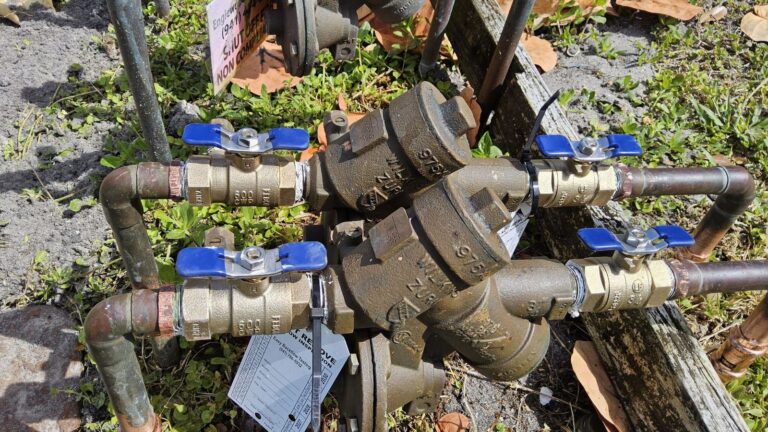
What this looks like in practice: an annual postcard or letter shows up, you call a registered tester (us at (941) 786-8434, or any Florida BAT-certified tester), the test happens, the report gets filed, you get a copy of the certificate. Total time on site is about twenty minutes for a residential PVB.
Scenario 2: Single-family rental: landlord pays (almost always)
You rent a single-family home in Florida. The landlord pays for backflow testing. The lease almost always specifies it that way for two reasons. First, the device is a fixture of the property and Florida residential leases generally treat plumbing fixtures as the landlord’s compliance responsibility. Second, the utility test notice goes to the customer of record at the meter, which is usually the landlord on a rental property even when the tenant pays the water usage.
The exception is a rare type of lease (a true triple-net residential lease, almost never used in Florida residential rentals) where the tenant takes on all property compliance including backflow testing. If your residential lease is a standard Florida boilerplate or anything resembling FAR/BAR or FREC standard forms, the landlord pays. Period.
What if the landlord ignores the notice? The tenant should still call (941) 786-8434 to flag it for the landlord, and in Florida the tenant has the right to put rent in escrow under FS 83.60 if the landlord fails to maintain compliant utilities. Backflow non-compliance can lead to water shutoff, which qualifies.
Scenario 3: Condo: depends on which device serves your unit or the common area
Florida condos are the trickiest case for sorting out responsibility because there are usually two backflow devices in play. There is a master device on the building’s domestic water service (paid by the association out of dues) and there are sometimes individual unit-level devices on irrigation lines or specialty fixtures (paid by the unit owner).
For a 2-bedroom Florida condo on a typical complex, the master backflow on the building service is the HOA’s responsibility. If your unit has its own backflow on a private patio irrigation line or a unit-level fire sprinkler tap, the unit owner pays. The condo declaration document spells out the line between common-element devices and unit-element devices.
If you cannot find your declaration, call the property manager and ask which devices are flagged for unit-owner billing. They will know.
Scenario 4: HOA with shared irrigation: the HOA pays via dues
Many Charlotte County HOAs maintain shared landscape irrigation across the common areas. The backflow device on that shared irrigation line is unambiguously the HOA’s responsibility. The HOA pays for backflow testing through the regular dues budget, the property management company books the testers, and the cost is amortized across all owners.
If your HOA also maintains entry fountains, pool fill lines, or amenity-center water features with their own dedicated backflow devices, those are HOA-billed too.
Where it gets unclear: a homeowner inside an HOA who has their OWN backflow on their OWN irrigation meter. That is a private device on a private meter, and the homeowner pays even though the HOA exists. Confused? See our HOA backflow compliance guide for the full breakdown by device type.
Scenario 5: Commercial tenant in a leased unit: depends on the lease
Florida commercial leases vary. The two most common structures cover almost every case for who pays for backflow testing:
A NNN (triple-net) lease passes property-level compliance costs to the tenant. The tenant pays for backflow testing on devices serving their leased space, even though the landlord owns the building. NNN tenants in Charlotte County industrial parks, retail strips, and standalone commercial properties almost always pay.
A modified gross or full-service gross lease keeps property-level compliance with the landlord as a cost included in the base rent. The tenant does not pay separately, but the cost is baked into the rent number. Common in office leases.
If you do not know which type of lease you signed, the answer is in the section usually labeled “Operating Expenses,” “CAM” (Common Area Maintenance), or “Compliance Costs.” It will say either “tenant” or “landlord” responsible for water utility compliance, plumbing fixture testing, or similar language.
What your lease or HOA docs probably already say
Most Florida residential and commercial leases settle the who-pays-for-backflow-testing question in language that mentions one of these phrases:
- “Plumbing fixtures and water service compliance”
- “Tenant utilities” (vs. “landlord utilities”)
- “Operating expenses” or “CAM charges”
- “Property-level testing and certification”
- “Utility-required inspections”
If you see any of those phrases, follow the assignment they make. Tenant pays means tenant pays. Landlord pays means landlord pays.
For HOA properties, the document is the Declaration of Condominium or the Master HOA covenants. Look for the section on “common elements” versus “limited common elements” versus “unit-owner responsibility.” Backflow devices follow the meter they protect. If the meter is on a common element, the HOA pays. If the meter is dedicated to a unit, the unit owner pays.
What happens if nobody pays in time
The utility shutoff is on the meter, not on the person. North Port Utilities and Englewood Water District both have published procedures for what happens when an annual backflow test is not filed inside the grace window:
- A notice of non-compliance is sent to the customer of record
- A grace window of about 30 days (residential) opens
- If no passing test is filed, the utility schedules water shutoff at the meter
- The shutoff stays in place until a passing certified test is filed by a registered tester
This is why “I rent, I will let the landlord deal with it” backfires. The water gets shut off at the meter, the tenant living at the property loses water, and the dispute over who pays for backflow testing turns into an emergency call to a tester at 6 PM on a Friday. The right move is to flag the notice to the responsible party the day it arrives, in writing, with a deadline.
For a step-by-step on how the filing actually works once the test happens, see how to file your backflow test report in Florida.
How to settle who pays for backflow testing in 60 seconds
If you are reading this with a notice in hand and you are not sure if you owe the test cost or not, here is the 60-second decision tree:
- Look at the water bill. Whose name is on it? That is the customer of record and the legal default.
- Look at your lease or HOA document. Find the section on plumbing, water, utilities, or compliance. Read what it says about testing and inspection costs.
- If the lease/HOA contradicts the bill (you pay the bill but the lease says landlord pays the testing), the lease wins for billing back. The landlord still has to pay the tester directly because only the customer of record can authorize the work; they bill you back if the lease assigns it to you.
- If you cannot find the answer in your documents, call us at (941) 786-8434. Sixty seconds on the phone with the device size and the utility name and we can usually tell you exactly who Charlotte County treats as the responsible party for the address.
If you have already decided you are responsible, book the test through our contact form or call directly. We will be on site within the week, file the report the same day, and email you a paid receipt for billing back.
For the broader compliance picture, the complete Charlotte County backflow testing guide covers every step from the notice arriving in the mail to the compliant flag posting at the utility.
FAQ
Can my landlord bill me back for backflow testing in Florida?
Yes, if the lease assigns the cost to the tenant. Most Florida residential leases do not. Most Florida commercial NNN leases do. Read your specific lease for “operating expenses,” “CAM charges,” or “tenant compliance costs” to confirm.
My HOA covers the front yard but I have a separate backflow device in the back. Who pays?
You do, if the back device is on your private meter or your private irrigation line. The HOA only pays for devices on common-element meters. If you are not sure which meter your back device is on, the property manager or the utility can tell you in one phone call.
Can a tenant book the backflow test directly?
Sometimes. The tester needs the customer of record (whoever is on the water bill) to authorize the work for the report to be filed correctly. If the tenant is the customer of record on a direct-billed lease, yes. If the landlord is the customer of record (which is more common), the tenant should flag the notice to the landlord and let the landlord book it.
What if the property is in foreclosure or probate?
The lender or estate is the property owner during foreclosure or probate. They are technically responsible for backflow testing compliance, but in practice the utility will work with whoever is currently at the address to keep water service uninterrupted. Call (941) 786-8434 if this is your situation. We have handled enough of these to know the workaround.
Does Florida law actually require backflow testing?
Yes. Florida Administrative Code 62-555 requires annual certified testing on any backflow device serving a property with a cross-connection to the public water supply. That covers irrigation systems, fire lines, pool fill lines, dedicated irrigation meters, and most commercial water services in Charlotte County.
Settle it once, then book the test
Most Florida property owners are surprised the first time the backflow test notice arrives because the device has been sitting there for years and nobody mentioned it at closing. Once you know who’s responsible at your specific property, the rest is straightforward: a registered tester comes out, runs the gauge for about twenty minutes, files the report with North Port Utilities or Englewood Water District the same day, and you are good for another year.
Call (941) 786-8434 and we will tell you who pays in about sixty seconds based on your address and your utility, then book the test on the same call. Or request a quote online and we will follow up the next business day.
For the official rules behind all of this, see the Florida Department of Environmental Protection cross-connection control program and verify any tester you hire on the Florida DBPR licensee lookup.