Fire Line Backflow Testing in Florida: A Trusted 2026 Compliance Guide
Fire line backflow testing in Florida is the specific annual test on the backflow assembly protecting a fire-sprinkler riser from cross-contaminating the public water supply. Most commercial properties in North Port and Englewood have one (a DCV or DCDA on the fire-line connection), and Florida law requires the assembly to be tested annually by a BAT-certified tester who is approved for fire-line work by your specific utility. That last detail catches a lot of commercial property managers off guard.
This guide walks what fire-line backflow testing actually involves in Florida, why fire-line is a separate testing designation from general backflow testing, and what to confirm before booking any tester for a commercial fire-line job.
Table of contents
- What fire line backflow testing actually is
- Why fire line is a separate tester designation in Florida
- Common fire line backflow devices in Florida commercial properties
- The annual fire line backflow test on site
- Filing the fire line backflow test report
- Frequently asked questions

What fire line backflow testing actually is
Fire-sprinkler systems are plumbed off the same potable water service that feeds the rest of the building. That direct connection creates a cross-connection between the sprinkler line (which sits full of water, sometimes for years) and the public water supply. Without backflow protection, water inside the sprinkler line could flow backward into the clean supply, contaminating water for everyone downstream on the main.
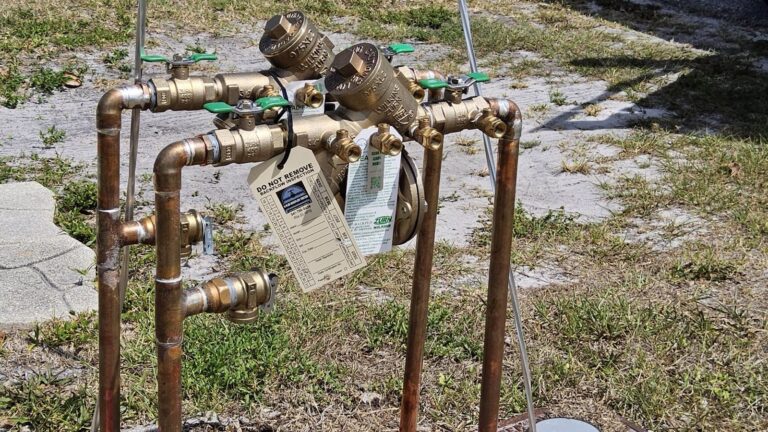
Florida Administrative Code 62-555.360(2) and most local water utility regulations require a backflow preventer on the fire-line connection. The most common device is a DCV (Double Check Valve) or DCDA (Double Check Detector Assembly). On a high-hazard commercial fire line, an RPZ may be required instead.
The annual fire-line backflow test verifies that both check valves on the DCV/DCDA still hold differential pressure against reverse flow, and (on a DCDA) that the bypass meter still reads correctly. The test runs on a calibrated differential pressure gauge, and the certified test report gets filed with your water utility.
Why fire line is a separate tester designation in Florida
This is the detail that surprises most commercial property managers. In Charlotte County, both utilities split their tester registration into two categories:
- General backflow testing. Authorizes a BAT-certified tester to test residential and commercial assemblies that are not on a fire line.
- Fire-line backflow testing. A separate designation authorizing the tester to test fire-sprinkler risers and file fire-line reports specifically.
A tester approved for general backflow testing is not automatically approved for fire-line testing. Reports filed by a general-only tester on a fire-line device get rejected at filing in Englewood. North Port’s portal handles fire-line filings under the same registration but expects fire-line reports to be flagged accordingly.
The Englewood Water District publishes the split designation publicly on the EWD Backflow Testers page. General testers and fire-line testers appear as separate sections of the list. Before booking any tester for a fire-line job in Englewood, confirm the tester appears under the fire-line section.
A Plus Backflow Testing carries both designations: registered on the North Port Utilities portal for both general and fire-line work, and listed on the EWD approved-tester page in both sections. That matters for commercial properties with a mix of general and fire-line devices because one tester can handle the full portfolio with one filing pass.
Common fire line backflow devices in Florida commercial properties
Three device types cover the overwhelming majority of fire-line installations we test across Charlotte County commercial properties.
DCV (Double Check Valve) on small commercial fire lines
DCV assemblies use two check valves in series. They protect against backsiphonage and low-pressure backpressure but do not include the bypass meter found on a DCDA. Common on smaller commercial properties with a single-zone fire-sprinkler system. Common Charlotte County models include Febco 805Y and Apollo 4ALF in DCV configuration.
DCDA (Double Check Detector Assembly) on most commercial fire risers
DCDA is the standard for commercial fire-line protection in most of Charlotte County. The DCDA is essentially a DCV plus a bypass meter that lets the utility detect any unusual flow through the fire-line connection. If sprinklers activate or if there is a leak in the fire-line piping, the bypass meter registers the flow. The annual test runs both check valves and verifies the bypass meter reads correctly. Sizing typically runs four-inch up to ten-inch depending on building size.
RPZ (Reduced Pressure Zone) on high-hazard fire lines
A handful of high-hazard commercial fire-line installations require an RPZ instead of a DCV/DCDA. This includes properties where the sprinkler line has been treated with antifreeze, where there is direct chemical injection, or where the building authority has determined the hazard rating warrants the upgrade. RPZ test runs longer than DCV/DCDA testing and includes the relief valve.
For a deeper read on the three device types, see our DCV vs RPZ vs PVB device comparison.
The annual fire line backflow test on site
A typical commercial fire-line DCDA test runs about 45 minutes to an hour on site depending on assembly size and access. Larger commercial DCDA or fire-line RPZ can run longer.
The on-site procedure:
- We confirm the device, model, and meter (including the bypass meter reading on a DCDA).
- We attach a calibrated differential pressure gauge to the test ports on the assembly.
- We close the shutoffs in sequence and run each check valve through its cycle, recording the differential pressure readings.
- On an RPZ, we also run the relief valve through its cycle.
- On a DCDA, we verify the bypass meter reads correctly under a controlled flow.
- We restore the shutoffs and re-verify the assembly holds pressure.
- We sign the certified test report with the BAT certification number (BAT #PR14723), the gauge serial, the calibration certificate reference, the date, and the readings.
We file the report with your water utility the same business day. The property manager receives the signed PDF the same business day.
Filing the fire line backflow test report
The filing process is the part where the fire-line tester designation matters most. Both Charlotte County utilities expect fire-line reports to come from a tester carrying the fire-line authorization.
North Port fire-line filing
For North Port commercial fire-line work, we file the certified test report through the North Port Utilities Cross-Connection Control portal the same business day. The portal accepts fire-line reports under the same registered-tester registration and flags them as fire-line in the compliance record. Your property’s fire-line compliance updates in real time through the portal.
Englewood fire-line filing
For Englewood Water District commercial fire-line work, we file through the EWD approved-tester email process the same business day. EWD processes the submission within one to two business days. Because we carry the fire-line designation on the EWD list, the report goes through cleanly. A general-only tester’s fire-line report would get bounced back at this step.
For more on the filing process and what each utility wants on a certified test report, see our how to file your backflow test report in Florida guide.
Frequently asked questions
Is fire line backflow testing required annually in Florida?
Yes. Florida Administrative Code 62-555.360(2) and most local water utility regulations require annual certified testing on the backflow assembly protecting the fire-line connection. The test is in addition to (not in place of) any periodic fire-sprinkler system inspection required by your fire marshal.
Can A Plus test our entire commercial portfolio including fire lines?
Yes. A Plus carries both the general and fire-line backflow tester designations on the North Port Utilities portal and the Englewood Water District approved-tester list. Commercial properties with a mix of general and fire-line devices can use one tester for the full portfolio. For HOA and multi-device portfolio scheduling, see our HOA backflow compliance Florida guide.
How long does a commercial fire line backflow test take?
About 45 minutes to an hour for a typical commercial DCDA in Charlotte County. Larger DCDA or fire-line RPZ assemblies run longer depending on size and access. Schedule access to the fire-line riser room during the booking call so the tester is not waiting for keys on the day of the visit.
Do you handle DCDA testing on commercial properties in North Port and Englewood?
Yes. DCDA is the most common fire-line device we test across Charlotte County commercial properties. We carry the right gauge and the right manufacturer test procedures for the common models (Febco, Apollo, Zurn Wilkins).
What does fire line backflow testing cost in Charlotte County?
Pricing varies by device type, device size, and access. Commercial DCDA testing is priced separately from general backflow testing because the on-site time and the test procedure are different. Call (941) 786-8434 for a two-minute quote with your portfolio details.
Ready to schedule your fire line backflow test?
Call (941) 786-8434 or request a quote online. Florida BAT #PR14723. Fire-line designated on both North Port Utilities and Englewood Water District. Same-business-day filing.
Related reading for commercial property managers: